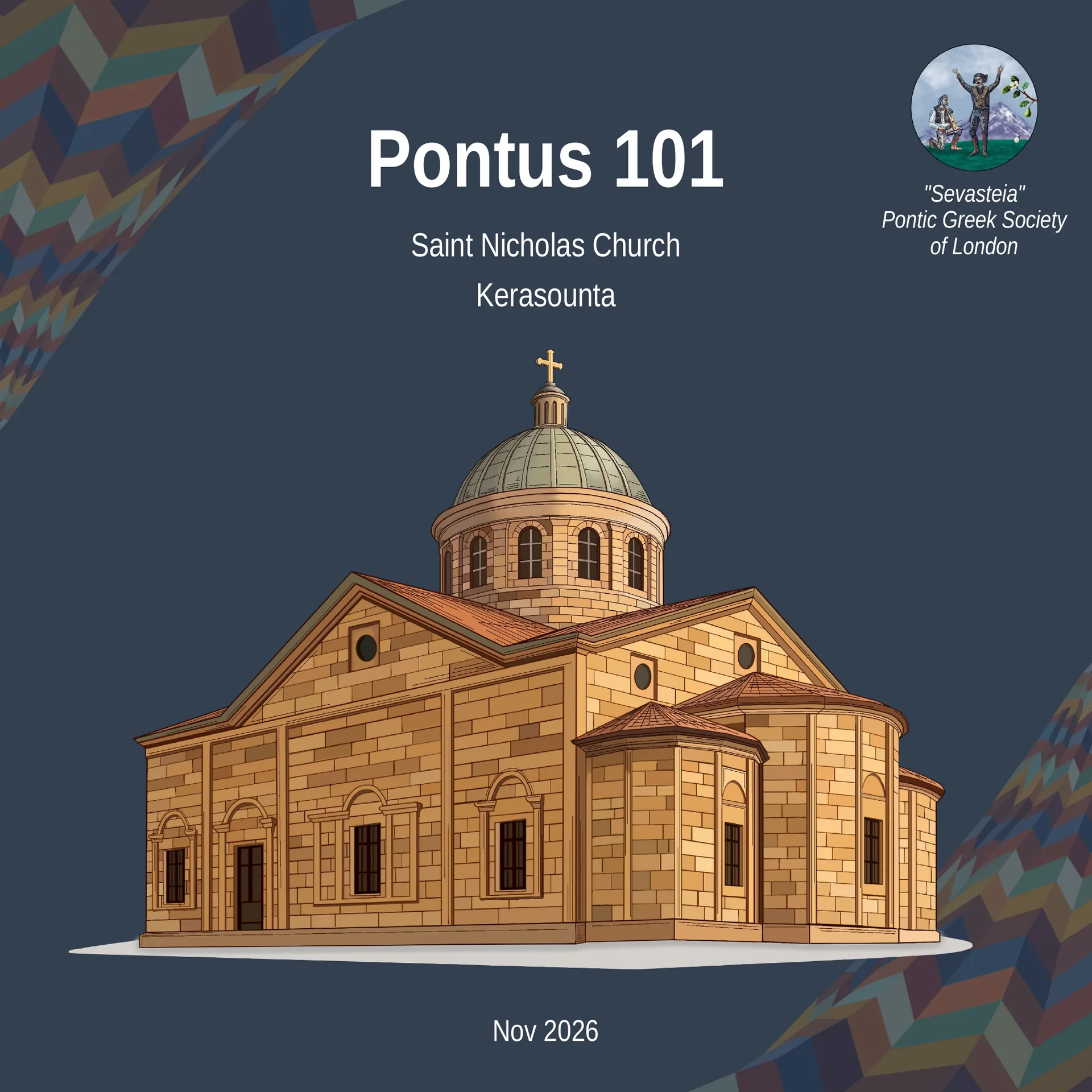
Saint Nicholas Church, Kerasounta
How a church of the Pontic Greek community of Kerasounta became Giresun Museum, traced through travellers’ accounts, surveys and a property plaque
What stories can a single church tell about the history of an entire community?
In Kerasounta (modern-day Giresun, Türkiye), the Church of Saint Nicholas, also known as Gogora Church, stands as a reminder of the city's Pontic Greek Orthodox heritage.
Through nineteenth-century travellers’ accounts, historical research and the testimony of Ioannis Papadopoulos, a native of Kerasounta, we explore the church's history, architecture and original dedication. We also examine a possible connection with earlier Byzantine remains — a hypothesis that has yet to be conclusively established.
Following the population exchange of 1923–1924, the church ceased to function as a place of worship. Over the following decades, it served several different purposes, including as a prison, before being restored and reopening as Giresun Museum in 1988.
The carousel also features historical photographs, the surviving fresco of Christ Pantocrator, and a fascinating property inscription from a house opposite the church, offering a glimpse into the lives of the neighbourhood's former residents.
The presentation also includes my original digital illustration of the church, hand-painted entirely in Krita without the use of AI.
A journey through history, architecture and the enduring memory of Kerasounta's Greek Orthodox community.
Sources
Bryer, A., with Winfield, D., Ballance, S., and Isaac, J. (2002). The Post-Byzantine Monuments of the Pontos: A Source Book. Aldershot: Ashgate. See Part 3, pp. 233–235, Plate 66.
Hamilton, W. J. (1842). Researches in Asia Minor, Pontus, and Armenia: With Some Account of Their Antiquities and Geology. Vol. I. London: John Murray, pp. 261–265.
Okuyucu, D. (2013). Orta ve Doğu Karadeniz Bölgesi Rum Kiliseleri [Greek Orthodox Churches of the Central and Eastern Black Sea Region]. Doctoral dissertation, Atatürk University, pp. 82–83.
Özcan, Z. (1997). Greek Orthodox Churches in Anatolia. Structural Studies, Repairs and Maintenance of Historical Buildings, Transactions on the Built Environment, Vol. 26. WIT Press, pp. 45–55 (esp. pp. 50–52).
Papadopoulos, I. N. (1965). Pages from the History of Kerasounta and the Atrocities of Topal Osman throughout the Region of Pontus. Published by I. Papadopoulos, printed by I. Konstantinou, Kavala, pp. 13–14.
Texier, C. (1862). Asie Mineure: Description géographique, historique et archéologique des provinces et des villes de la Chersonnèse d’Asie [Asia Minor: A Geographical, Historical, and Archaeological Description of the Provinces and Cities of the Asian Peninsula]. Paris: Firmin Didot Frères, Fils et Cie, Chapter XXIII, p. 619.
Turkish Ministry of Culture and Tourism (n.d.). Giresun Müzesi [Giresun Museum]. Kültür Portalı. https://www.kulturportali.gov.tr/turkiye/giresun/gezilecekyer/giresun-muzesi
Turkish Museums (n.d.). Giresun Müzesi [Giresun Museum]. https://www.turkishmuseums.com/museum/detail/2053-giresun-muzesi/2053/1